


Should I Still Invest in Google Ads?

The short answer is wes, but with a clear-eyed understanding that the platform's efficiency is declining. Paid CTRs on queries with Google AI Overviews have fallen 68% since mid-2024. Conversion rates dropped across 13 of 14 industries in 2025. You can still generate leads through Google Ads, but you need to know where the platform is losing effectiveness and adjust your strategy accordingly.
Is AI search replacing Google search? Not yet in volume terms, but the trajectory is unambiguous. Google's global search share fell to its lowest point in a decade in 2025. AI platforms like ChatGPT grew from 300 million to 900 million weekly users in 14 months. AI-referred traffic converts 4.4 times better than organic Google traffic. The shift is real, it's measurable, and it's accelerating.
Every generation of business owners has faced the same inflection point: the channel that made you visible yesterday stops being reliable, a new one emerges, and the businesses that adapt early win while those that wait scramble to catch up. We watched it happen when Google dismantled the Yellow Pages. We're watching it happen again right now with AI search and Google. The question isn't whether the shift is happening. The data confirms it is. The question is what you should actually do about it.
Let's start with the history, because it makes the present considerably easier to understand.
Every generation of business owners has faced the same inflection point: the channel that made you visible yesterday stops being reliable, a new one emerges, and the businesses that adapt early win while those that wait scramble to catch up. We watched it happen when Google dismantled the Yellow Pages. We're watching it happen again right now with AI search and Google. The question isn't whether the shift is happening. The data confirms it is. The question is what you should actually do about it.
Let's start with the history, because it makes the present considerably easier to understand.
We've Seen This Shift Before
In the 1980s and early 1990s, if you ran a business and wanted customers to find you, the Yellow Pages was your only serious option. You paid for your listing, competed for the biggest box, and waited for the phone to ring. It worked. Yellow Pages advertising peaked at $14.7 billion annually at its height, and the entire industry was still generating $26 billion globally as recently as 2009.
Then Google made the directory irrelevant. Not slowly — in historical terms, almost overnight. By 2015, Yellow Pages advertising revenue had crashed to $3.2 billion. By 2024, it sat at approximately $1.1 billion. The businesses that had built their entire customer acquisition strategy around a printed directory became invisible — not because they'd done anything wrong, but because the world had moved on and left the directory behind.
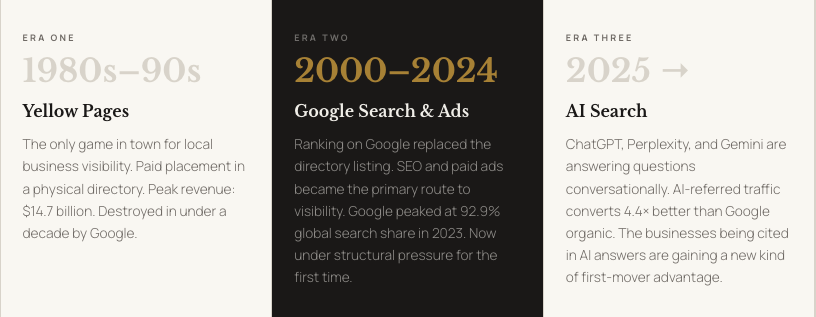
The parallel between Google's current situation and Yellow Pages in the early 2000s is specific. Both dominated information discovery in their era. Both built enormous revenue models around that dominance. Both faced a new technology that answered the user's question faster, more conversationally, and with less friction than the incumbent could offer. Yellow Pages tried to adapt — it built digital directories, partnered with Google, moved listings online — but the business model couldn't survive the shift in how people found information. Google now faces the same structural problem, and the early data shows it.
Is AI Search Replacing Google Search? What the Data Says
Is AI search replacing Google search? Based on the evidence available in 2026, the honest answer is: not yet in total volume, but the trend lines are clear and consistent, and they're moving in one direction.
Google still processes an estimated 8.5 to 13.6 billion searches every day. It still commands close to 90% of the global search market. Declaring Google dead would be as premature as declaring Yellow Pages dead in 2005 — it was still generating billions in revenue, but the trajectory had already changed permanently. What matters isn't where Google is today. It's where it's heading, and how fast.
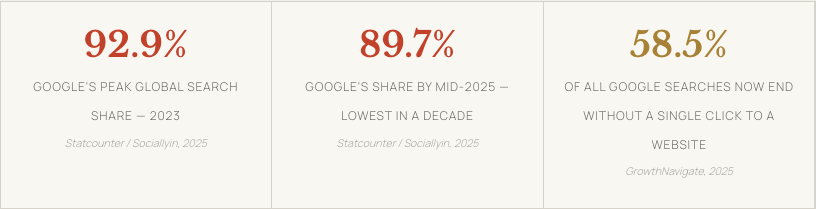
That zero-click figure is the most important number on this page for any business that relies on Google traffic. More than half of all Google searches now end without a user clicking through to any website at all. Google's own AI Overviews — the summary boxes that appear above organic results — answer the question directly on the results page. The click never happens. Gartner predicts that search engine-driven website traffic will fall by 25% by 2026 as a direct consequence.
Apple's own usage data underlined the same shift. In April 2025, Google searches through Safari saw their first year-on-year decrease in over 20 years. Apple's senior executive Eddie Cue confirmed the reason: people were using generative AI instead.
Meanwhile, AI platforms are growing at a rate that has no precedent in the history of consumer internet technology. Is AI search replacing Google search in the way a direct swap might look? No. Is it siphoning enough intent, attention, and query volume to matter to your business? Increasingly, yes.
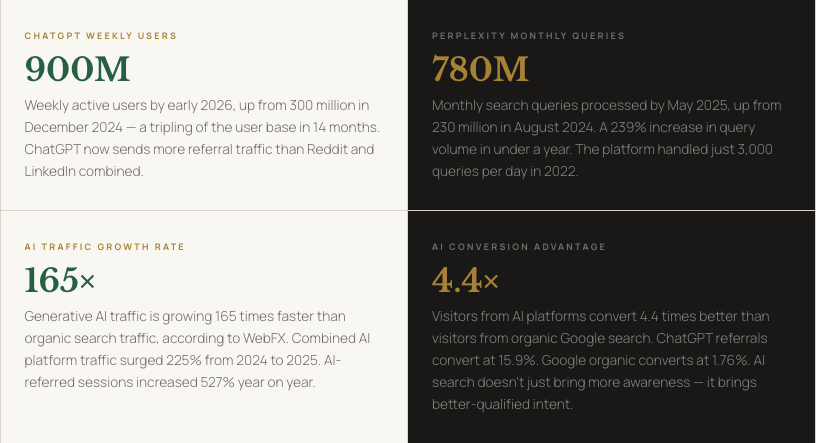
The businesses that won in the Google era didn't wait until Google was dominant. They invested while it was still growing. That window in AI search is open right now — and it's closing faster than most people realise.
Should I Still Invest in Google Ads? The Honest Answer.
Should you still invest in Google Ads? Yes — but with a fundamentally different understanding of what you're buying than was true three years ago. The platform still works. It still generates leads for businesses across most industries. But the efficiency of that investment is declining in ways that are now clearly documented, and if you're not accounting for that in your strategy, you're spending money on a deteriorating asset without adjusting for the depreciation.
Here is what the data shows about Google Ads performance between 2024 and 2025:
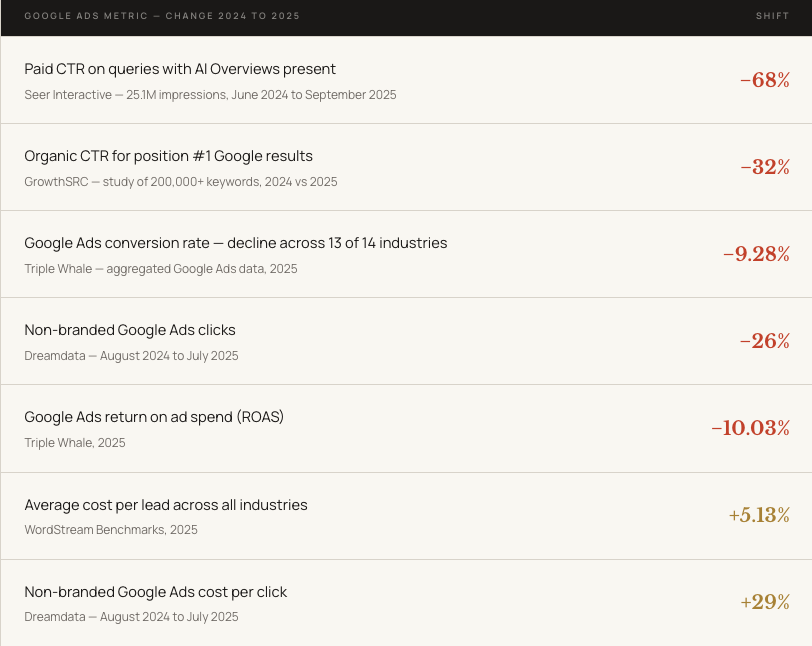
In plain language: you're paying more per click, reaching fewer people, converting a lower proportion of the ones you do reach, and your return on ad spend is down more than 10% year on year. The AI Overviews appearing above your ads are intercepting queries before users even see what you've paid to show them — and on those queries, paid click-through rates have collapsed 68%.
So should you still invest in Google Ads? Yes, if you're targeting the right queries, measuring properly, and not treating the platform the way you treated it in 2022. No, if you're running the same campaigns with the same assumptions and expecting the same results. The platform hasn't broken. The world around it has changed, and your strategy needs to change with it.
The real risk right now
The businesses most exposed aren't the ones who've stopped investing in Google Ads. They're the ones still spending the same budgets, measuring the same metrics, and assuming declining performance is a campaign problem rather than a structural one. If your cost per lead is rising and your conversion rate is falling, the campaign is probably fine. The landscape it's operating in has shifted.
What Smart Businesses Are Doing Right Now
The answer to "should I still invest in Google Ads?" isn't to abandon the platform. It's to stop treating it as your only channel and to start building visibility in the places your customers are increasingly starting their search.
Search isn't dying. It's changing. The businesses that understand the difference — and act on it — are the ones that will still be visible when the dust settles. -Ian Wilson. Marketing Sales Managememt Ltd

Getting more sales for your business is easier than you think

Understand how CRMs can help your business generate more revenue and improve customer experience